

From a Functional to a Free Society-- The End of Economic Man: Drucker's Diagnosis of Totalitarianism

Bo Yang Ph.D.

PUBLISHED:

December 10, 2025

Peter Drucker suggested that readers view his first three books as a unified body of work: The End of Economic Man(1939), The Future of Industrial Man (1942), and Concept of the Corporation (1946). These works share a common theme: politics. Drucker did not think about politics like scholars who strictly follow modern social science norms. Instead, he viewed politics as part of social ecology and understood political events through the dynamic changes in social ecology.


Despite having "corporation" in its title and using General Motors as a case study, Concept of the Corporation is indeed a book about politics. In this work, Drucker attempts to address the main issues that industrial society must resolve: the legitimacy of managerial authority, the status and function of managers and workers, and the power structure of society and organizations. In Drucker's own words, this is a book exploring the specific principles of industrial society. Corresponding to these specific social principles, Drucker had earlier attempted to develop a general social theory, which was the aim of The End of Economic Man and The Future of Industrial Man.


The subtitle of The End of Economic Man is "The Origins of Totalitarianism." The book focuses on how society disintegrates in industrial societies and how totalitarianism rises. For Drucker, the real challenge of this topic isn't explaining how Hitler and Mussolini came to power, nor the actions of Germany and Italy in government, military, and economic spheres. Rather, it's understanding why some Europeans accepted clearly absurd totalitarian ideologies, and why others seemed potentially receptive to them.


Drucker's writing style is argumentative. He clearly knew that to effectively advance his arguments, he needed to engage with popular theories of his time. Back then, there were two main explanatory approaches to Nazism and Fascism, which Drucker termed "illusions." Some viewed totalitarianism as ordinary political turmoil similar to previous historical revolutions. In their view, totalitarianism was characterized merely by cruelty, disruption of order, propaganda, and manipulation. Others considered totalitarianism a phenomenon unique to Germany and Italy, related to their specific national characters.


Drucker thoroughly refuted explanations based on "national character." He believed that any historical approach appealing to "national character" was pseudo-history. Such theories always emphasize that certain events were inevitable in certain places. But all claims of "inevitability" negate human free will and thus deny politics: without human choice, there is no politics. If the rise of totalitarianism were inevitable, there would be no need or possibility to oppose it.


Viewing totalitarianism as an ordinary revolution is equally dangerous. This thinking merely emphasizes how bad Nazis and Fascists were. But the real issue is that Europeans were not merely submitting out of fear—they were actually attracted to totalitarianism. And those attracted weren't just the ignorant masses but also well-educated intellectual elites, especially the younger generation. The world cannot defeat totalitarianism through contempt alone, especially if that contempt stems from ignorance. Understanding the enemy is a prerequisite to defeating it.


Drucker identified three main characteristics of Nazism and Fascism (totalitarianism is a social type, with Nazism and Fascism being its representatives in industrialized Europe):


1.      The complete rejection of freedom and equality, which are the core beliefs of European civilization, without offering any positive alternative beliefs.


2.      The complete rejection of the promise of legitimate power. Power must have legitimacy—this is a long-standing tradition in European politics. For power to have legitimacy means that it makes a commitment to the fundamental beliefs of civilization. Totalitarianism denied all European beliefs, thereby liberating power from the burden of responsibility.


3.      The discovery and exploitation of mass psychology: in times of absolute despair, the more absurd something is, the more people are willing to believe it.


The End of Economic Man develops a diagnosis of totalitarianism around these three characteristics. Drucker offers a deeper insight: totalitarianism is actually a solution to many chronic problems in industrial society. At a time when European industrial society was on the verge of collapse, totalitarians at least identified the problems and offered some solutions. This is why they possessed such magical appeal.


Why did totalitarianism completely reject the basic beliefs of European civilization? Drucker's answer: neither traditional capitalism nor Marxist socialism could fulfill their promises of freedom and equality. "Economic Man" in Drucker's book has a different meaning than in Adam Smith's work. "Economic Man" refers to people living in capitalist or socialist societies who believe that through economic progress, a free and equal world would "automatically" emerge. The reality was that capitalism's economic freedom exacerbated social inequality, while socialism not only failed to eliminate inequality but created an even more rigid privileged class. Since neither capitalism nor socialism could "automatically" realize freedom and equality, Europeans lost faith in both systems. Simultaneously, they lost faith in freedom and equality themselves. Throughout European history, people sought freedom and equality in different social domains. In the 19th century, people projected their pursuit of freedom and equality onto the economic sphere. The industrial realities of the 20th century, along with the Great Depression and war, shattered these hopes. People didn't know where else to look for freedom and equality. The emerging totalitarianism offered a subversive answer: freedom and equality aren't worth pursuing; race and the leader are the true beliefs.


Why did totalitarianism reject the promise of power legitimacy? One reason was that political power abandoned its responsibility to European core beliefs. Another reason came from the new realities of industrial society. Drucker held a lifelong view: the key distinction between industrial society and 19th-century commercial society was the separation of ownership and management. The role of capitalists was no longer important. Those who truly dominated the social industrial sphere were corporate managers and executives. These people effectively held decisive power but had not gained political and social status matching their power. When a class's power and political status don't match, it doesn't know how to properly use its power. Drucker believed this was a problem all industrial societies must solve. Totalitarianism keenly perceived this issue. The Nazis maintained property rights for business owners but brought the management of factories and companies under government control. This way, social power and political power became unified. This unified power was no longer restricted or regulated—it became the rule itself.


Why could totalitarianism make the masses believe absurd things? Because Europeans had nothing left to believe in. Each individual can only understand society and their own life when they have status and function. Those thrown out of normal life by the Great Depression and war lost their status and function. For them, society was a desperate dark jungle. Even those who temporarily kept their jobs didn't know the meaning of their current life. The Nazi system could provide a sense of meaning in this vacuum of meaning—though false, it was timely. Using the wartime economic system, the Nazis created stable employment in a short time. In the Nazi industrial system, both business owners and workers were exploited. But outside the industrial production system, Nazis created various revolutionary organizations and movements. In those organizations and movements, poor workers became leaders, while business owners and professors became servants. In the hysterical revolutionary fervor, people regained status and function. Economic interests were no longer important, freedom and equality were no longer important; being involved in the revolution (status) and dying for it (function) became life's meaning. The Nazis replaced the calm and shrewd "Economic Man" with the hysterical "Heroic Man." Though absurd, this new concept of humanity had appeal. What people needed was not rationality but a sense of meaning that could temporarily fill the void.


Those theorists who despised totalitarianism only emphasized its evil. Drucker, however, emphasized its appeal. He viewed totalitarianism as one solution to the crisis of industrial society. From 19th-century commercial society to 20th-century industrial society, the reality of society changed dramatically. 19th-century ideas, institutions, and habits could not solve 20th-century problems. Capitalism could not fulfill its promises about freedom and equality, and neither could Marxism. It was at this point that totalitarianism emerged. Nazism and Fascism attempted to build a new society in a way completely different from European civilization. Drucker said the real danger was not that they couldn't succeed, but that they almost did. They addressed the relationship between political power and social power, proposed alternative beliefs to freedom and equality (though only negative ones), and on this basis provided social members with new status and function.


The war against totalitarianism cannot be waged merely through contempt. Defeating totalitarianism is not just a battlefield matter. Those who hate totalitarianism and love freedom must find better solutions than totalitarianism to build a normally functioning and free industrial society.

Totalitarianism gave wrong and evil answers. But they at least asked the right questions. Industrial society must address several issues: the legitimacy of power (government power and social power), individual status and function, and society's basic beliefs. These issues became the fundamental threads in Drucker's exploration of industrial society reconstruction in The Future of Industrial Man.


The Future of Industrial Man: From Totalitarian Diagnosis to General Social Theory


Both The End of Economic Man and The Future of Industrial Man feature the prose style of 19th-century historians. Even today, readers can appreciate the author's profound historical knowledge and wise historical commentary. For today's readers, the real challenge of these two books lies in Drucker's theoretical interests. He doesn't simply narrate history but organizes and explains historical facts using his unique beliefs and methods.


In The End of Economic Man, Drucker developed his diagnosis of totalitarianism around three issues: power legitimacy, individual status-function, and society's basic beliefs. In The Future of Industrial Man, he also constructs a general social theory around these three issues.

In "What Is A Functioning Society," Drucker explains three sets of tensions that exist in social ecology:
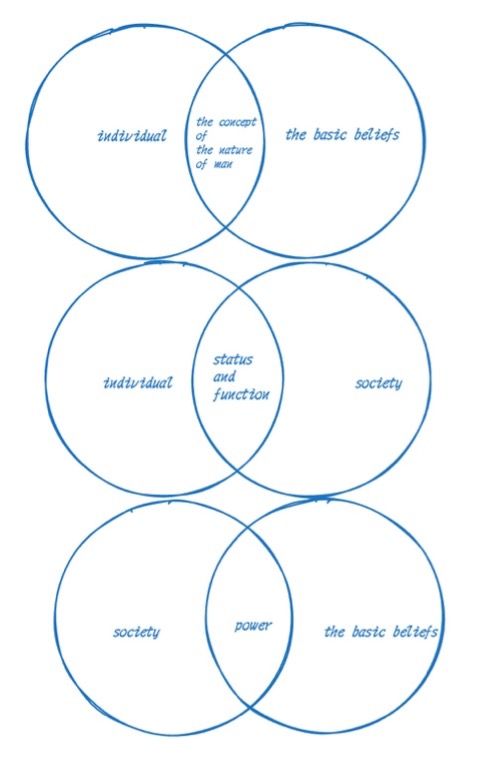
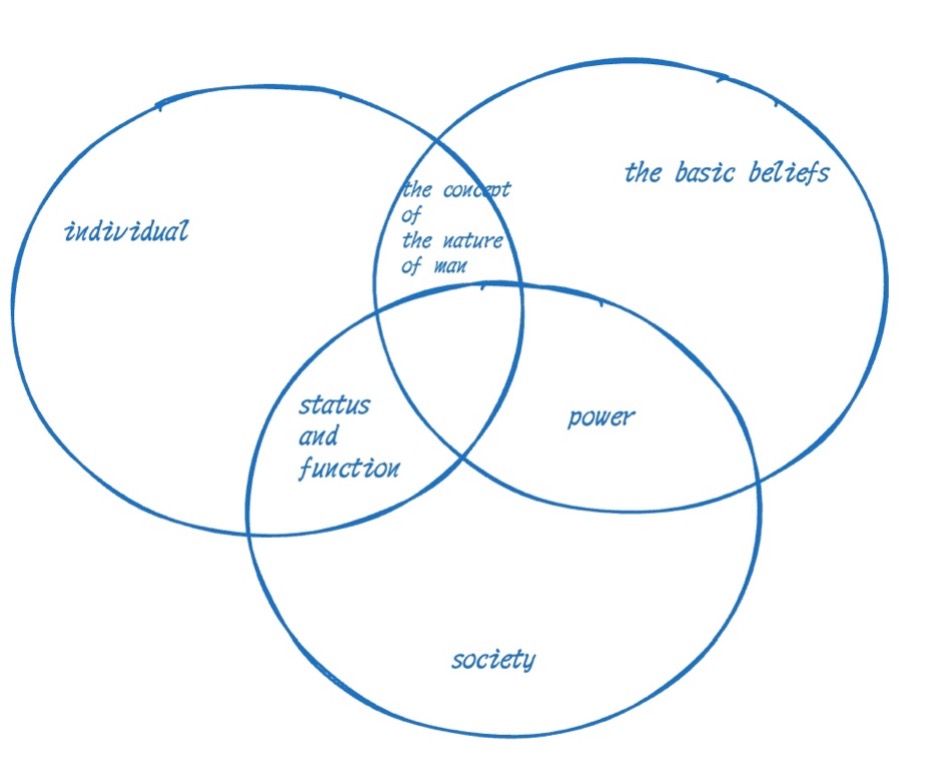
Tension between the individual and society's basic beliefs. "Society's basic beliefs" refer to two questions every society must answer: What is human? How should humans achieve fulfillment in life? Christianity provided answers to these questions, while Hinduism and Buddhism offered different answers. European society as a whole is a Christian civilization. Throughout its long history, Europeans' understanding of these two questions was shaped by Christianity. However, in different historical periods, Europeans sought their fulfillment in different social domains, leading to different "concepts of the nature of man" such as Spiritual Man, Intellectual Man, and Economic Man. Spiritual Man, Intellectual Man, and Economic Man all pursued the freedom and equality revealed by Christianity, but they sought these in entirely different domains. Thus, we have one set of tension: the tension between individuals and beliefs about human nature, with the "concept of human nature" serving as the mediator of this tension.


Tension between the individual and society, with individual status-function serving as the mediator of this tension. Traditional political philosophy often falls into debates between individualism and collectivism. Collectivism attempts to subtract the individual from society, while individualism attempts to subtract society from the individual. Drucker believes that if we use arithmetic language for analogy, the relationship between individual and society should not be subtraction but multiplication. When individuals have status-function, social life becomes meaningful. When society can bestow status-function upon individuals, it integrates social members and creates a meaningful social order.


Tension between society's basic beliefs and society itself, with power serving as the mediator of this tension. Any society needs to be organized according to specific beliefs. But beliefs alone cannot create society. What truly creates organization and order in society is power. It is real power that transforms lofty beliefs into concrete society.


The three sets of tensions interweave into a network. Within this network, each pole of tension must function for the other pole. The relationship between the two poles is a functional relationship. Their reason for existence is not themselves but the function they perform for external things. This is Drucker's basic approach to observing social ecology.


A functioning society can take many different forms because different societies uphold different beliefs. Christian societies and Hindu societies cannot be identical, but they can both be functioning societies. Regardless of how much societies differ in beliefs and appearances, a functioning society has essential elements:


Power must have legitimacy. For power to have legitimacy means that a society's dominant power (governmental power, social power) must commit to this society's basic beliefs and work according to these beliefs.


Society can bestow status-function upon individuals. Moreover, individuals' status-function aligns with society members' basic beliefs about human nature.


In a society, individuals have basic beliefs about "who am I" and "how should I exist."


A functioning society is not a "good" society or a "perfect" society. It has nothing to do with judgments like "good" or "perfect." As soon as we mention "good" or "perfect," we introduce specific value preferences. "What Is A Functioning Society" tells readers that, based on any value preference, it's possible to construct a functioning society or to make society paralyzed and disintegrate. A liberal who loves freedom, despite loving freedom, might be powerless to construct a functioning society because they cannot harness power or create visions for society and individuals.


"Free Society and Free Government" addresses how to construct a functioning free society based on belief in freedom.


Drucker's understanding of freedom belongs to the Christian tradition, not the 19th-century liberal tradition. He explains freedom from the perspective of the three sets of tensions:


Freedom exists in the tension between individuals and beliefs about human nature: "The only basis of freedom is the Christian concept of man's nature: imperfect, weak, a sinner, and dust destined unto dust; yet made in God's image and responsible for his actions." From this Christian expression of freedom, Drucker distills several elements of freedom: 1) Humans are imperfect and cannot be perfect; 2) Humans are God's creation and thus yearn for truth; 3) Humans must make choices because of their imperfection and must be responsible for their choices because they yearn for truth.


Freedom exists in the tension between individuals and society. Freedom is primarily a life experience of each individual, but individuals must live out freedom in social life. In social life, freedom is an organizational principle. Freedom as an organizational principle means allowing individuals to bear choice and responsibility. Where there is no choice, there is no freedom; where there is choice without accompanying responsibility, there is also no freedom.


Freedom exists in the tension between society and social beliefs. If a society has faith in the freedom revealed by Christianity, then the power of this society must use freedom as an organizational principle. Specifically, every society has two power centers: government power and social power. Therefore, free government and free society need to be discussed separately.


Elements of a free government: organized, legal, with defined power scope, responsible, and self-governing.

Elements of a free society: In society's constructive domains, people organize actions according to the principle of "choice-responsibility." Constructive social domains refer to different social areas where people project their beliefs about freedom in different societies. In some eras, people seek freedom in religious life; in others, they seek it in economic life. Those domains that allow people to place their beliefs in them and can inspire people's courage and creativity are constructive social domains. If a society's constructive domains are organized by freedom as a principle, we can say it is a free society.


The relationship between government power and social power: A free society should have a dualistic pattern of government and society. Government is a necessary condition for society's operation. But there must be a self-governing social domain to balance it. In the 19th century, this self-governing social domain was the market. In the 20th century, Drucker believed this self-governing social domain should be commercial enterprises and social organizations.


Drucker openly acknowledges that his understanding of free government and free society derives from the Christian tradition. In his view, one crisis of political thought is that people are often unaware of the origins of their political thinking. For instance, people frequently confuse the questions of "free government" and "best government." The inquiry into "free government" stems from Christianity, while the inquiry into "best government" comes from ancient Greece. The desire to find or create the "best government" is a long-standing impulse. This idea presupposes that humans can achieve perfection. If a perfect individual or a perfect group emerges, then the government run by them would be a "perfect government." Similarly, if a perfect individual or group proposes a perfect plan or system, then a government ruling according to this plan or system would be a "perfect government."


Even in the 20th century, even in freedom-loving America, people often forget that "free government" and "best government" are two different things. Those who love democracy frequently assert that democratic government is the "best government." Of course, followers of totalitarianism also assert that totalitarian government is the "best government." Drucker says the real danger is that any obsession with the "best government" will eventually lead to enslavement. This is because illusions such as "best," "perfect," or "ultimate" deprive citizens of choice and responsibility. Freedom, however, is precisely responsible choice.


In other chapters of The Future of Industrial Man, Drucker reveals two paths to defending freedom. One path: the conservatives of 1776, starting from Christian beliefs about the human heart, explored political and social innovations in Britain and America. The other path: 19th-century liberals believed that humans could achieve perfection through their own efforts; starting from their love of freedom, they walked the path of enslavement leading to totalitarianism.


General Social Theory and Drucker's Management Science


The social ecological perspective and understanding of freedom that Drucker demonstrated in The End of Economic Man and The Future of Industrial Man run through all his political and management writings.


Key themes in his work include:


Continuously tracking new social realities, identifying decisive social powers, and exploring how to give power legitimacy.


Defending the dualistic pattern of government power and social power. Studying changes in the nature of government, answering what it should do, can do, and cannot do. Studying how to organize society, building organizational theory, and exploring the legitimacy of organizational power.


Paying attention to the interaction between social beliefs and social reality, and the interaction among technology, population, and beliefs.


Caring about individuals' status and function within organizations.


Exploring how to apply freedom as an organizational principle to organizational structure design and work design.





By Robert Kirkland Ph.D. March 8, 2026
When Rosalind Brewer stepped into the role of CEO of Sam’s Club in 2017, she inherited a stable but somewhat traditional retail operation. Sam’s Club already had millions of members and a recognizable presence across the United States. Yet the retail environment around it was shifting quickly. E commerce was expanding, customer expectations were changing, and warehouse clubs were beginning to compete not only with one another but also with companies like Amazon that were redefining convenience. Brewer entered at a moment when stability could easily become complacency. Brewer’s leadership at Sam’s Club may suggest a contemporary example of what Peter Drucker called Management as a Liberal Art. Drucker argued that management should not be treated as a purely technical discipline. Instead, it draws from economics, psychology, ethics, and history while placing human judgment at the center of decision making (Drucker, 1989). In practice this means leaders must think about institutions as part of society rather than as isolated profit machines. Brewer’s decisions at Sam’s Club appear to reflect this broader way of thinking. One of Brewer’s earliest strategic moves surprised many observers. In 2018 the company announced the closure of dozens of underperforming Sam’s Club locations while simultaneously expanding investments in digital commerce and technology within remaining stores. At first glance the closures looked like a conventional cost cutting exercise. The larger strategy, however, suggested something more complex. Brewer seemed to be repositioning the organization around a changing retail landscape in which convenience and digital integration were becoming essential to survival (Peterson, 2018). Peter Drucker often emphasized that leaders must confront changing realities rather than preserve outdated organizational structures (Drucker, 1999). Retail history offers plenty of examples where firms waited too long to adapt. Department store chains that once dominated American shopping districts declined rapidly once consumer habits shifted toward online platforms and large format retailers. Brewer’s decision to close stores may have reflected an attempt to avoid that kind of institutional inertia. Technology became another defining feature of Brewer’s leadership at Sam’s Club. The company expanded its “Scan and Go” mobile application, allowing customers to scan products while walking through the store and complete payment directly through their phones. Anyone who has waited in a long checkout line at a warehouse club can probably appreciate why this small change matters. It removes one of the most frustrating moments in the shopping experience. Drucker frequently argued that innovation often begins by observing everyday inconveniences faced by ordinary people (Drucker, 1985). Brewer’s focus on reducing friction inside the store may reflect that perspective. Instead of treating technology as a flashy marketing tool, Sam’s Club applied it to mundane problems like lines, payment processing, and product availability. These changes rarely make headlines, but they often reshape how customers experience a company. Brewer’s leadership also intersected with questions of workplace culture. Drucker wrote decades earlier that organizations must provide employees with both status and function, meaning a sense of identity and the ability to contribute meaningfully to the organization (Drucker, 1946). Retail environments are not always known for empowering frontline workers, yet Brewer supported initiatives that expanded training programs and increased wages for certain hourly roles across Walmart owned stores (Walmart Inc., 2019). Representation also became part of Brewer’s public leadership. She has spoken openly about diversity in corporate leadership and the importance of expanding opportunities for people who historically have been underrepresented in executive positions. At one point earlier in her career she announced that she would decline invitations to speak on conference panels composed entirely of white men. The statement generated debate in corporate circles, but it also forced many organizations to reconsider how they structure leadership conversations (Green, 2018). From the perspective of Management as a Liberal Art, these discussions may matter more than they first appear. Drucker argued that institutions derive legitimacy from the societies in which they operate (Drucker, 1989). If leadership structures fail to reflect the diversity of those societies, organizations risk appearing detached from the communities they serve. Brewer’s stance suggested that representation was not merely symbolic. It was connected to how companies understand markets, employees, and legitimacy. Financial performance during Brewer’s tenure complicates the common claim that attention to social issues weakens corporate performance. Sam’s Club reported rising membership numbers and strong sales growth during this period while also investing heavily in digital infrastructure (Walmart Inc., 2020). These outcomes may support Drucker’s long standing argument that responsible management and economic effectiveness are not mutually exclusive. In many cases the two appear to reinforce each other. Still, the relationship between corporate responsibility and profitability remains debated. Critics sometimes argue that large companies emphasize social initiatives primarily for reputational benefits. Brewer’s leadership does not eliminate that possibility. Corporate strategies often involve a mix of genuine values and pragmatic calculation. Yet Drucker himself acknowledged that moral and economic motives frequently intersect inside organizations (Drucker, 1999). Expecting perfect separation between them may be unrealistic. Brewer’s later appointment as CEO of Walgreens Boots Alliance in 2021 further illustrates the demand for leaders capable of managing both operational complexity and cultural change. Large corporations increasingly operate under intense scrutiny from consumers, employees, and investors. Leaders must respond not only to financial pressures but also to broader social expectations regarding fairness, sustainability, and transparency. Reflecting on Brewer’s tenure at Sam’s Club, one sees a leadership approach that blends operational pragmatism with a broader awareness of institutional responsibility. She pursued technological upgrades, reorganized store operations, and participated in conversations about diversity and representation within corporate leadership. None of these actions alone redefine modern management. Together, though, they may suggest a style of leadership that aligns closely with Drucker’s idea of Management as a Liberal Art. In the end, Drucker believed that management is fundamentally about stewardship. Organizations exist within a web of relationships that include employees, customers, suppliers, and communities (Drucker, 1989). Brewer’s career offers a contemporary reminder that effective leadership often requires navigating all of those relationships at once. Financial success remains essential, of course. Yet long term legitimacy may depend just as much on whether institutions demonstrate awareness of their broader responsibilities. References: Drucker, P. F. (1946). The concept of the corporation. New York, NY: The John Day Company. Drucker, P. F. (1985). Innovation and entrepreneurship. New York, NY: HarperBusiness. Drucker, P. F. (1989). The new realities: In government and politics, in economics and business, in society and world view. New York, NY: Harper & Row. Drucker, P. F. (1999). Management challenges for the 21st century. New York, NY: HarperBusiness. Green, J. (2018). Rosalind Brewer pushes corporate America to diversify leadership. Bloomberg Businessweek. Peterson, H. (2018). Sam’s Club closes dozens of stores as it focuses on e commerce growth. Business Insider. Walmart Inc. (2019). Walmart and Sam’s Club associate opportunity report. Walmart Inc. Walmart Inc. (2020). Walmart annual report 2020. Walmart Inc. 
By 拜伦·拉米雷斯博士和杨伯博士 March 7, 2026
当我们描述领导者时,我们经常提到他们影响他人的能力。几十年来,学者们一直专注于研究这种影响力是如何运作的,以及为什么它往往能引起人们的积极反应,使他们受到鼓舞去追随领导者的愿景。 我们了解过那种神秘的说服他人并引导他们朝共同目标前进的能力。然而,在分析领导者时,还有另一个方面值得考虑——他们的权力源自何处,这种权力是否被视为合法?这些问题意在暗示,当我们分析领导者与追随者的互动时,应该思考他们的关系是如何建立的,更重要的是,领导者如何运用权力来塑造这些关系。 让我们首先讨论什么是权力以及为什么它很重要。广义上的权力是影响、领导、支配或影响他人行动的能力。德国社会学家马克斯·韦伯将权力定义为在社会关系中创造预期结果的能力。因此,权力使领导者能够影响和引导人们的行动。 合法权力通常指个人从组织权威层级中的正式职位或岗位获得的权力。正是这种权威的概念帮助追随者认可权力的合法性。例如,经理对下属拥有合法权力,可以分配任务;教师在课堂上拥有合法权力,可以评定成绩和设定学习目标。我们可以推断,合法权力基于职位或头衔所赋予的权威,而个人之所以服从有权威者的要求或决定,是因为他们认可该职位持有者的权威。 然而,与暗示合法性的权威不同,权力可以非法行使。历史告诉我们,有许多例子表明,权力并非简单地源于权威和合法性,而是来自于胁迫。约瑟夫·斯大林及其大恐怖运动就是一个典型例子。虽然斯大林确实拥有"权威"地位,但他的大部分权力和影响力本质上是强制性和欺骗性的。实际上,斯大林一生都利用他的政治职位来"清除"对手,同时在追求更大个人权力的过程中提升自己的形象。根据传记作者罗伯特·塞维斯(2005)的说法,斯大林以贬低和羞辱他人为乐,让即使是亲密的同事也处于"不间断的恐惧"状态。 当然,还有其他使用强制性权力来获取服从的例子。强制性权力的一个更常见例子是,经理利用降职或解雇的威胁来让员工服从。因此,当我们考虑领导者(经理)的影响力时,我们应该考虑其权力的本质和来源。人们跟随领导者是因为他们真正被领导者的愿景所激励,还是因为他们别无选择? 威胁他人工作安全以确保服从的经理,为个人利益而滥用职位的领导者,或者通过偏袒而非功绩晋升的个人——这些都是非法权力的表现。无论在什么情况下,非法权力往往会降低士气,限制创造力,并培养有毒环境,让人们出于恐惧而非目标感行事。非法权力在没有道德理由、伦理价值或受影响者同意的情况下施加影响。由于这种形式的权力往往源于操纵、胁迫、恐吓或剥削,而非对人的真诚尊重,它会破坏信任,滋生恐惧,腐蚀组织和社区的伦理基础。 使用威胁、惩罚或心理压力强制服从的强制性领导者,可能会取得短期成果,但长期代价巨大。强制剥夺了个人自主权,创造了怨恨和疏离的环境。人们表面上可能会服从,但内心可能会退缩、抵抗或离开。此外,强制性领导阻碍了开放对话和建设性反馈,而这些对创新、成长和持续改进至关重要。当恐惧成为主要动力时,组织和社会变得停滞、僵化,容易崩溃。 这就引出了一个重要问题——合法权力是什么样的?在这个问题上,彼得·德鲁克提供了独特的见解。 在他的第一本书《经济人的终结》(1939)中,德鲁克讨论了合法权力的问题(虽然他没有使用合法权力这个术语,而是用权威的合理性)。德鲁克认为,统治者的权力必须具有合法性,这是自柏拉图和亚里士多德以来在西方文明中延续的传统。 在德鲁克看来,合法权力涉及权力、社会信念和社会现实之间的功能关系:权力是否承诺遵循社会信念?同时,它能否基于这种承诺有效地组织社会现实以创造秩序? 在他的著作《公司的概念》(1946)和《新社会》(1950)中,德鲁克开始同时使用合法权力和领导力这两个术语。德鲁克认为,致力于人民福祉的政府可以说拥有合法权力。随着时间推移,德鲁克将合法权力的分析从政治领域转向社会组织。根据德鲁克的观点,如果社会组织(如公司)的管理层声称其主要目的是使员工受益,这种特定的关注点将构成对权力的滥用。相反,德鲁克认为经济组织的首要使命始终是实现经济绩效,从而为社会做出贡献——这实际上是企业管理权力合法性的来源。当然,公司也是一个社区。对员工而言,管理层无疑拥有权力并必须行使它。然而,管理层权力的合法性不来自于使员工受益的承诺,而是来自两个功能: 通过制度设计和创新,塑造有效的社区沟通,使中低层员工能够获得组织的整体愿景。这使员工具有管理态度。 通过设定明确合理的绩效标准,促使员工承担责任并通过有效工作取得成功。 如果管理层能在组织内履行这些功能,则被视为行使合法权力。在德鲁克的早期著作中,行使合法权力几乎等同于领导力。德鲁克不热衷于讨论领导者的个人风格或魅力,他更不倾向于将领导力与神秘的说服他人能力联系起来,尤其是当这种说服涉及宣传、灌输或精神操纵时。对德鲁克而言,讨论领导力主要意味着使权力能够有效发挥作用。因此,领导力不是个别领导者的技巧和风格问题,而是权力本身的责任和功能问题。 从这些功能中,我们可以推断,合法权力与被领导者的目标、信念和愿望一致。拥有这种权力的领导者不需要求助于威胁或操纵。相反,他们激励、引导和协作。他们的权威被接受是因为它被视为公平、应得和对集体有益。培养从合法权力出发的领导者至关重要——这种权力是通过信任、专业知识、共同价值观和公认的权威授予的。 合法权力植根于经理通过其在组织中的角色获得的正式权威,但其真正力量来自于该权威如何行使。与强制性权力不同,合法权力被视为正当和适当的,因为它基于明确的期望、相互尊重和既定结构。当经理始终以公平、诚信和透明度行事时,他们的权威更有可能被团队接受并信任。这创造了一种健康的权力动态,员工对领导决策感到安心,了解自己的角色,并有动力为共同目标做出贡献。 经理可以通过使其行动与组织价值观保持一致,并展示能力、一致性和问责制来建立合法权力。例如,做出反映组织使命的决策并公平对待所有团队成员可以增强经理的可信度。沟通也是关键——积极倾听、提供明确指导并解释决策背后的理由的领导者能够培养信任和认同。投资个人成长、保持信息更新并树立良好的职业道德,都能强化经理应得其位并为团队和组织的最佳利益行事的认知。 当经理通过合法权力领导时,组织获得的好处是巨大的。团队更加投入,士气提高,协作增加,因为人们信任领导并与组织目标保持一致。这创造了一个积极的反馈循环,员工更有可能主动行动、创新并保持承诺,减少流动率并提高整体绩效。本质上,合法权力构成了可持续领导文化的基础——一种赋能个人、增强组织诚信并推动长期成功的文化。 培养通过合法权力施加影响的领导者需要转变我们定义和培养领导力的方式。这涉及优先考虑情商、伦理推理、透明度和同理心。这样的领导者体现正直和真实,使他们的决策与共同价值观和长期愿景保持一致。他们创造环境,让人们感到被重视、被倾听和被赋能。反过来,这培养了忠诚、参与和强烈的目标感。 要建立更健康的工作场所和更公正的社会,我们必须支持体现合法权力的领导者:那些不是通过恐惧,而是通过愿景、可信度和与共同价值观的一致性来施加影响的人。这种方法不仅促进道德领导,还培养信任、创新和集体福祉。  参考文献 Drucker, P. F. (1946). 《公司的概念》. 纽约: John Day Company Drucker, P. F. (1939). 《经济人的终结:对新极权主义的研究》. 纽约: John Day Company Drucker, P. F. (1950). 《新社会:工业秩序的解剖》. 纽约: Harper Service, R. (2005). 《斯大林:传记》. Belknap Press of Harvard University Press Weber, M. (1965). 《政治作为一种职业》. Fortress Press
By Bo Yang Ph.D. January 31, 2026
Peter Drucker’s memoir, Adventures of a Bystander, is a self-portrait of a most unusual kind. It reveals its subject not through direct autobiography, but through a series of incisive portraits of the people he encountered throughout a tumultuous life. Drucker positions himself as a "bystander," but this is no passive observer. Instead, he is an intellectual portraitist whose careful study of others becomes the very method by which he comes to understand himself and the fractured world he inhabited. The book’s central drama is framed by a vivid scene from the summer of 1940. Karl Polanyi, a brilliant economic historian and refugee from the war engulfing Europe, was staying with the young Drucker and his family in Vermont. Tormented by the news of France's surrender and the bombing of London, Polanyi was consumed by an agonizing question: "Why did this European catastrophe happen?" Each morning, as soon as he heard Drucker's infant daughter stir in her crib, he would rush into her room and pour out his developing theories, testing his grand intellectual framework on the most innocent of listeners. This single image captures the profound urgency that animates the book. For both Polanyi and Drucker, understanding the collapse of European civilization was not an abstract academic exercise; it was an existential necessity. To explain his unique perspective, Drucker employs the metaphor of the "bystander" as the "fireman in the theater." In old European theaters, two firemen were required to be present for every performance. They did not participate in the play, yet their presence was integral to it. From their unique vantage point, they saw the stage differently than the actors or the audience. Drucker clarifies that this viewpoint is not a simple reflection of reality. As he puts it, this kind of "reflection is a prism rather than a mirror; it refracts." In observing the world, the bystander sees reality broken down into its constituent parts, and in that refraction, he inevitably sees himself. This analysis will follow Drucker’s prismatic gaze. We will first explore his diagnosis of a European elite intellectually trapped by the failed ideas of the 19th century. We will then examine the desperate search for an exit from this intellectual prison, as seen through his dialogues with other brilliant minds on the edge of the abyss. Finally, we will uncover the alternative vision Drucker discovered—not in a grand ideology, but in the pragmatic realities of American society and the nascent practice of management. 1 Trapped in the 19th Century: The Collapse of a Worldview To comprehend the rise of 20th-century totalitarianism, Peter Drucker believed one must first understand the intellectual and imaginative paralysis of the European elites who preceded it. His portraits of the men and women of his youth are not mere nostalgic sketches; they are forensic examinations of a worldview in collapse. The catastrophe that befell Europe, he argues, was not caused by a sudden invasion of barbarism, but by an internal failure—a vacuum created when the continent’s leading minds became prisoners of their own history, unable to see, let alone confront, the monstrous new reality taking shape before them. Drucker uses the haunting metaphor of a "sunken city of Atlantis" to describe the Vienna—and by extension, the Europe—of his youth. He recalls a childhood story of a city whose inhabitants, punished for their pride and greed, are forced to live as the undead, re-enacting their empty rituals in a world without sunlight. For Drucker, this was the state of the European elite. They were the living dead, trapped in the illusion of a "prewar" world, going through the motions of a life that no longer existed. This clinging to the past was, in his words, a "miasmic smog... paralyzing everybody," stifling all thought and imagination. The Paralysis of the Liberals The first and most prominent group of prisoners were the 19th-century liberals among whom Drucker was raised. His own father, a high-ranking government official, simply could not believe that Hitler would invade Austria or that another great war was possible. The editors at the prestigious journal The Austrian Economist, men of international perspective, dismissed 18-year-old Drucker’s warnings about the rising Nazi movement as "Nonsense," convinced that electoral politics had solved the problem. Most damningly, Drucker recounts an episode at the liberal-minded Frankfurt University. After a Nazi official delivered an ominous speech to the faculty, the university’s most celebrated professor—a brilliant scientist and archetypal liberal—was expected to offer a rebuttal. Instead, he stood up and asked only one question: "Could you please clarify... will the research budget for physiology be increased?"  For Drucker, the liberals' catastrophic failure was therefore not moral but imaginative—a cognitive paralysis rooted in their unwavering faith in a 19th-century framework that was utterly unequipped to recognize, let alone combat, a radically new form of political evil. They saw the Nazis as crude and vulgar, a temporary aberration that could be managed with the old tools, never imagining a world where their own cherished principles were no longer relevant. The Disillusionment of the Socialists If the liberals failed because they could not imagine a world beyond the 19th century, the socialists failed because their imagination was entirely a reaction against it, leaving them equally blind to the political realities of the 20th. They correctly diagnosed the deep flaws of the old order but were tragically naive in their proposed solutions. Drucker tells the story of Count Traun-Trauneck, a brilliant young aristocrat who placed his faith in an international workers' movement, believing the solidarity of the proletariat could transcend national borders and prevent the coming war. His hopes were brutally shattered when that very movement was consumed by a tidal wave of nationalism, as the "workers of the world" eagerly marched off to kill one another. The Count, his faith destroyed, retreated into obscurity, a broken man. Even more cautionary is the tale of Noel Brailsford, a British dissenter who journeyed from liberalism to socialism out of a deep compassion for the oppressed. Horrified by Nazism, Brailsford adopted the desperate logic of "the enemy of my enemy is my friend," which led him to become an apologist for Stalin's Soviet Union. He knew of the atrocities, yet out of a desire to preserve a united front against fascism, he publicly defended the indefensible. Drucker saw in Brailsford a terrible paradox: a good man whose conscience led him to "condone evil." It was a lesson in how well-intentioned idealism, when detached from political reality, can become both morally compromised and politically naive. The Cul-de-Sac of Rationalism Drucker identified a deeper intellectual prison that held both liberals and socialists captive: "Rationalism." He was careful to distinguish this from reason itself. For Drucker, Rationalism is the arrogant impulse to force the mysterious, non-rational dimensions of human life into a single, quasi-scientific, all-encompassing explanatory system, mistaking the map for the territory. His prime example of this mindset is Sigmund Freud. In a masterful chapter, Drucker deconstructs three central "myths" about Freud: that he was impoverished, held back by anti-Semitism, and professionally neglected. In reality, Drucker argues, Freud was a quintessential "child of the Enlightenment." His great project was to take the dark, mysterious depths of the human psyche—the subconscious—and force them into a neat, rationalist framework. He promised a single key, sexual repression, that could unlock every human mystery. This quest for a perfect, totalizing explanation, Drucker argues, was the true intellectual disease of the 19th century. This rationalist obsession with a single, perfect system was the poison that contaminated the wells of European thought. It created an intellectual environment where even the most brilliant minds, in their search for an escape, would propose new, equally totalizing solutions—be it the perfect statesman, the perfect social design, or the perfect technology. 2. The Search for a Way Out: Dialogues on the Edge of an Abyss Drucker did not diagnose Europe's crisis from a detached, academic distance. His search for an answer was a lived experience, forged in intense dialogue with other thinkers who were also desperately seeking a path beyond the failed ideologies of the 19th century. In the portraits of his intellectual interlocutors—Fritz Kraemer, Karl Polanyi, Buckminster Fuller, and Marshall McLuhan—Drucker reveals a landscape of brilliant but ultimately flawed attempts to find an exit. The 'Third German' and Legitimate Power Fritz Kraemer was an eccentric political philosopher who provocatively advocated for monarchy, not out of nostalgia, but from a deeply held conviction that to resist the illegitimate, mob-driven power of Nazism, Germany needed a true conservatism grounded in legitimate authority and political virtue. He called for a "third German"—an "ideal Prussian"—to stand against both the corrupt "ugly German" of the establishment and the weak, ineffective "good German" of the liberal class. Drucker shared Kraemer's belief that the legitimacy of power was the central question of modern politics. Yet he ultimately diverged from Kraemer's solution, seeing it as too narrowly focused on the power of the state and overly reliant on the emergence of a "great man" to solve society's problems. The Perfect Society and the Embedded Market Drucker’s relationship with Karl Polanyi was one of the most formative of his life. Polanyi’s quest for an exit from the 19th-century trap was part of a larger family drama; each of his four siblings also pursued a radical alternative, from fascism and engineering a new society in Brazil to rural sociology and philosophical personalism, illustrating the sheer desperation of the search. Karl’s path was economic history. In his masterwork, The Great Transformation, he argued that the worship of a utopian "free market" was the root of social decay and proposed a "third way" in which the market would be "embedded" within social principles. Drucker, however, saw in Polanyi’s quest another form of the 19th-century impulse for "salvation by society." Polanyi’s own historical research became a source of disillusionment; he discovered that the pre-market societies he idealized were often built on slavery and coercion. Their fundamental difference was captured in Polanyi’s friendly dismissal of Drucker’s emerging philosophy as a "tepid compromise." Polanyi was searching for the perfect society; Drucker was beginning to formulate a vision for a tolerable one. The American Prophets and the Gospel of Technology After moving to America, Drucker encountered two thinkers who offered a completely different exit: technology. He called Buckminster Fuller and Marshall McLuhan true "prophets" because they understood that technology was not merely a set of tools but a new, formative reality. Fuller preached a technological "pantheism," seeing it as divine harmony, while McLuhan famously viewed it as an "extension of man," altering human perception itself. Drucker recognized their genius but warned against idolizing technology as a new "Golden Calf." To understand their difference from Drucker, one might imagine technology as a lamp. Fuller was concerned with whether the lamp's light aligned with the cosmic order of the stars. McLuhan was fascinated by how the lamp's light fundamentally altered our eyesight and perception of the world. Drucker, however, insisted on asking: Who is holding the lamp? What is the human 'work' of carrying it? And what social responsibilities does that act entail? For Drucker, these brilliant searches—for the perfect statesman, the perfect society, or the perfect technology—all pointed to a deeper modern pathology. The quest for "salvation by society," he concluded, had turned society itself into an idol. "Society" had become the "Great Baal and Moloch of modern man," a false god to which people were willing to sacrifice themselves and others in the pursuit of a worldly paradise. This deification of the social, he believed, was the ultimate source of totalitarian temptation. His own path, therefore, would require not a new system, but a new humility. 3. The American Alternative: Society, Politics, and Management Drucker’s escape from the European intellectual labyrinth was not just theoretical; it was geographical and experiential. In the United States, he discovered a society that, while deeply flawed, offered a living, breathing alternative to the rigid and failed ideologies of Europe. It was not a perfect society, but a functioning one, and in its functioning, he found the raw materials for a new political and social vision. An Imperfect but Resilient Society Drucker was struck by the profound difference in how Americans and Europeans responded to the Great Depression. In Europe, the economic collapse bred "suspicion, surliness, fear, and envy," tearing the social fabric apart. In America, he observed, the Depression was largely viewed as a "natural disaster." This perception fostered solidarity; the community "closed ranks" rather than dissolving into class warfare. He identified a key source of this resilience in what he termed American "Tribalism." Contrary to Marxist predictions, the crisis did not produce a unified "proletariat." Instead, Americans fell back on their diverse religious and ethnic communities. Drucker acknowledged the dark side of this phenomenon, distinguishing between "discrimination against" others and "discrimination for" one's own group. Yet he argued that this flawed mechanism provided a powerful source of social cohesion that prevented total social collapse. This mosaic of particular communities was held together by an overarching "American Creed"—a set of abstract principles to which anyone could swear allegiance. A Politics of Pragmatism, Not Perfection This unique social structure was mirrored in what Drucker called "America's political genius": a rejection of the European obsession with ideological perfection. The core of this tradition was a concept he called "dualism": a refusal to separate the material from the ideal. For Americans, politics was neither a dirty game of power (Machiavelli) nor the deification of the state (Hegel). Instead, it was a moral and creative act of making "matter serve spirit"—using imperfect institutions to strive for ethical ends. This pragmatic approach, Drucker saw, reflected a kind of "pre-modern," community-based wisdom that Europe, in its obsession with grand "isms," had lost. The fierce debate between individualism and collectivism, for example, was resolved through a vibrant tradition of "voluntary group action," where citizens organized from the bottom up to solve problems. This focus on concrete, community-based action over abstract theory was the political equivalent of the practical wisdom he admired in the "pre-modern" figures of his youth. The Organization as the Locus of Freedom Drucker's political philosophy found its ultimate practical application in an unlikely place: the modern business corporation. A two-year study of General Motors in the 1940s crystallized his thinking. He found himself in a debate with GM's legendary chairman, Alfred Sloan, who held that a corporation's only responsibility was economic performance. Drucker argued for a broader vision: in a world where traditional communities were dissolving, the large corporation had become the central social institution. As such, it had to provide workers with the social status and function that the old order no longer could. He found an unexpected ally in GM's president, Charles E. Wilson, a self-proclaimed "socialist." Wilson championed two groundbreaking ideas: the employee pension fund, which Drucker predicted would make workers the owners of American industry, and the "self-governing plant community," a direct response to Drucker's call for granting workers more autonomy. From these observations, Drucker forged his most groundbreaking insight. Tyranny thrives in a vacuum of social status and function. The well-managed organization, therefore, is not just an economic entity; it is the primary non-governmental institution capable of providing individuals with the status, function, and community that prevent the alienation on which totalitarianism feeds. Management, understood correctly, was the concrete "alternative to tyranny." 4. The Enduring Mystery of the Person After a lifetime spent analyzing the grand ideologies that defined the 20th century, Peter Drucker’s ultimate answer to its crises lay not in a new system, but in a return to the irreducible and mysterious nature of the human person. The ideologies had failed because they were abstractions; they forgot the messy, contradictory reality of individual human beings. The way out was to recover a form of wisdom that looked unflinchingly at people as they are. The "Pre-Modern" Wisdom Drucker found this wisdom embodied not in great theorists, but in "pre-modern" figures. His grandmother dismissed complex economic theories with a simple analogy: a ruler cannot change its length and then claim people have grown taller. Confronted by a Nazi, she didn't argue ideology; she poked him with her umbrella and told him his swastika was as impolite as a pimple on his face—and he sheepishly removed it. Similarly, the dynamic salon hostess Genia Schwarzwald had a profound disdain for all "isms." Her passion was for solving concrete problems. As Drucker notes, her famous salon was not just a hub of intellectual life, but a compassionate "counter-world" she created as a refuge for the "old-time liberals" and other elites who felt trapped in the "sunken city" of a collapsing Europe. When a massive strike loomed, she forcefully intervened, knocking heads together. When accused of forcing both sides to betray their principles, she delivered a line that summarized her entire philosophy: "I have no use for principles which demand human sacrifice." Lessons from the "Men of Action" Drucker found further proof of this principle in the practical wisdom of the bankers and businessmen he met. The banker Ernest Freedberg insisted that any system must be "'foolproof,' because work is ultimately done by fools." The retail magnate Henry Bernheim taught him that "There are no irrational customers, only lazy merchants." Their insights were a constant reminder that effective action comes from observing people's actual behavior, not from imposing abstract models upon them. Drucker's Ultimate Insight Drucker’s entire intellectual journey was a movement toward this fundamental truth. As a young man, he had a startling religious insight: "The opposite of Sin... is not Virtue; it is Faith." Years later, while sitting in John Maynard Keynes's legendary economics seminar, he had a professional epiphany, realizing that everyone else in the room, including Keynes himself, was interested "in the behavior of commodities," whereas he was interested "in the behavior of people." This focus on the human person in all their complexity led him to his most profound conclusions. He came to see the problem of slavery in America not as a mere political mistake, but as a "sin"—a deep moral and spiritual wound that could only be healed by repentance and redemption. He was shaken to his core when a Black theologian argued that true freedom for Black Americans required confronting not only the sin of white oppression but also the "guilt and mystery" of their own African ancestors' role in the slave trade. For Peter Drucker, the bystander who had witnessed the collapse of a world, the most profound social and political problems were, at their root, moral and spiritual problems of the human heart. To escape the prisons of ideology, one must have the courage to set aside the quest for perfect systems and turn instead to the difficult, humbling, and ultimately liberating task of looking unflinchingly at the full, mysterious, and often contradictory nature of the person.
Show More